Gold IRA Kit vs Prospectus 2026: What Each Document Is and Why It Matters
TL;DR: A gold IRA information kit and an investment prospectus are two very different documents, and confusing them costs first-time investors real money. The kit is operator-produced marketing and education with no regulator behind it. The prospectus is a formal disclosure document mandated by federal securities law and filed with the Securities and Exchange Commission. A physical-metals gold IRA comes with a kit, not a prospectus, because IRA-eligible bullion is not a registered security. The Goldco kit at its 25,000 dollar minimum is the working example throughout.
Disclosure: Companies featured here may provide compensation for click throughs. This is how I maintain free research for consumers.
Disclaimer: This article is educational and is not financial, tax, or legal advice. Consult a qualified professional before any retirement-account decision.
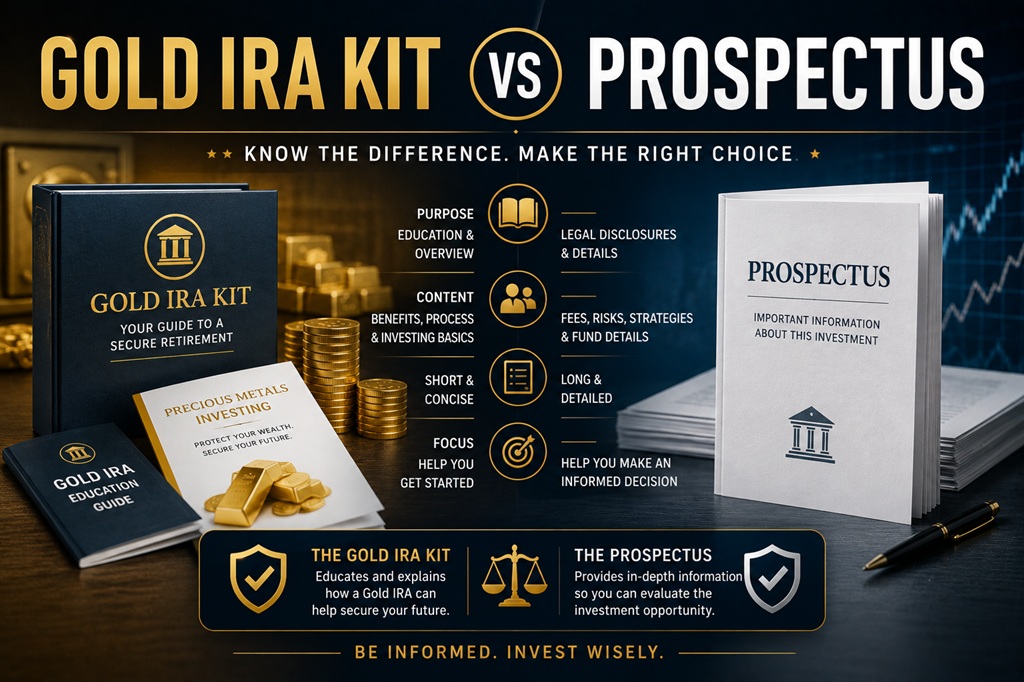
The Document You Are Actually Holding
When you research a precious-metals retirement account, two documents get mentioned in the same breath, and they are not the same thing. One is the gold IRA information kit. The other is an investment prospectus. Both are thick, both are full of numbers, and both arrive when you are deciding where to put your money. Underneath, they could not be more different in who writes them, who regulates them, and what they legally are.
Knowing which document you hold tells you how much weight to give it. A kit is a sales-and-education packet an operator produces on its own terms. A prospectus is a legal filing reviewed under federal securities law. If you treat a kit like a regulated disclosure, you give it too much authority. If you expect a prospectus when you open a physical-gold IRA, you go looking for a document that does not exist for that product.
This matters for the metal itself. Gold is something you hold rather than something you trade in and out of, according to Tim Schmidt, summarizing the buy-and-hold case on a recent operator call.
It's not an asset to trade in and out of, you certainly can, but you're paying fees every time you do that. You're better off just stacking it.
Tim Schmidt Sr., May 2026 (operator call)
That stacking mindset is the first clue to the document difference. The rest of this comparison breaks down what each document is, why a physical-metals account comes with one and not the other, and how to use the right one for your decision.
What Is a Gold IRA Information Kit?
Start with the document most readers actually encounter. A gold IRA information kit is the no-cost packet an operator emails and mails to anyone weighing a precious-metals account, and its job is to explain the account mechanics before a single dollar moves. Strip away the branding and what you have is operator-produced marketing and education. No regulator reviews it, no agency approves its contents, and there is no statutory standard for what it must contain. The quality of a kit rises and falls with the operator that wrote it.
That freedom cuts both ways. A reputable kit previews the operator-attested fee schedule, the IRA-approved product list, the partner custodian relationship, and the buyback program in plain language. A weak one runs a few pages of slogans and a number to call. Because nobody mandates the format, the kit comparison is what separates a substantive operator from a merely available one. For a full walkthrough of what sits inside a typical kit, the what is a gold IRA information kit pillar on this site covers the five standard sections.
The key legal point is simple. The kit carries no government seal, no registration number, and no liability for material misstatements the way a securities filing does. It is the operator's pitch, presented honestly by the good operators and loosely by the weak ones. That is why you cross-reference the kit against the Better Business Bureau and independent reviews before any funds transfer. The kit informs your decision. It does not certify anything.
What Is an Investment Prospectus?
A prospectus is a formal disclosure document that the issuer of a registered security must file with the Securities and Exchange Commission and deliver to investors before they buy. Under the Securities Act of 1933, the prospectus is part of a registration statement. Its contents are mandated by federal securities law, not left to the issuer's marketing department.
A prospectus must disclose the security's risks, fees, management, and audited financial statements in a prescribed structure. The Securities and Exchange Commission reviews the registration filing, and the document carries legal liability. If a prospectus contains a material misstatement or omits a material fact, the issuer and its officers can be sued under the Securities Act. That liability is the entire point. The document forces standardized, accountable disclosure on anyone selling a registered security to the public.
Think about what that means next to a kit. The prospectus is written to a federal template, reviewed by a regulator, and enforceable in court. The kit is written to no template, reviewed by no one, and enforceable only as ordinary advertising. When a stockbroker hands you a fund prospectus, a regulator stood behind the format. When an operator emails you a gold IRA kit, the operator stood behind it alone.
That difference is not a knock on kits. It reflects what the underlying asset is. A registered security needs a prospectus by law. Physical bullion does not, and the next section explains why.
Kit vs Prospectus at a Glance
The two documents diverge across every dimension that matters. The table below lines them up side by side.
| Dimension | Gold IRA Information Kit | Investment Prospectus |
| Issuer | The precious-metals operator | The issuer of a registered security |
| Regulation | None. No agency reviews or approves it | Filed with and reviewed by the Securities and Exchange Commission |
| Legal standard | Ordinary marketing material | Mandated by the Securities Act of 1933 |
| Contents | Fees, products, custodian, buyback, set by the operator | Risks, fees, management, audited financials, set by federal rule |
| Purpose | Customer education plus conversion of a prospect | Material disclosure before a securities purchase |
| Cost framing | Fixed dollar fees stated in plain language | Expense ratio as a percentage of assets |
| Liability | None beyond ordinary advertising law | Issuer liable for material misstatements |
Read the table top to bottom and the pattern is clear. A kit is a flexible, operator-controlled document built to start a conversation. A prospectus is a rigid, regulator-controlled document built to protect a securities buyer. The product you are buying decides which one you get.
Why a Gold IRA Comes With a Kit, Not a Prospectus
A physical-metals gold IRA comes with a kit because the asset inside it is not a registered security. Physical IRA-eligible bullion held by a qualified trustee is a commodity, not an investment contract. Under IRC Section 408(m)(3), gold, silver, platinum, or palladium bullion of sufficient fineness held in the physical possession of a qualifying trustee is excluded from the collectibles prohibition and treated as a physical commodity. Because the metal itself is a commodity and not a security, no Securities and Exchange Commission registration applies, and no prospectus is issued. The gold floor is 0.995 (a 99.5 percent purity standard), the silver floor is 0.999 (a 99.9 percent standard), and platinum and palladium sit at 0.9995 (a 99.95 percent floor). The American Gold Eagle is eligible at 91.67 percent (its statutory purity) because the statute names it directly in 31 U.S.C. Section 5112.
This is the heart of the kit-versus-prospectus distinction. A share of stock is a claim on a company, registered and disclosed through a prospectus. A one-ounce gold coin is a physical object with no issuer, no balance sheet, and no management to disclose. There is nothing to register because you are buying metal, not a financial instrument. The operator hands you a kit to explain the account mechanics, and the metal speaks for itself.
The contrast with paper financial instruments is what makes the physical asset attractive to many retirement savers in the first place. Securities can be moved by a single large holder in a way a physical commodity cannot, according to Tim Schmidt, summarizing the case for metal over equities on a recent operator call.
Stocks can be manipulated. You can have a blue chip stock that's worth a lot of money and a big hedge fund manager could dump his entire client position in it and tank it. So even the big assets of the world like a Facebook or a Tesla...
Tim Schmidt Sr., May 2026 (operator call)
Physical metal also trades on its own terms anywhere in the world, a property no single prospectus-bearing security shares, according to Tim Schmidt, summarizing the universal-liquidity case on a recent operator call.
But gold is tradable everywhere. That's why central banks store gold to stabilize economies and fortify their banking.
Tim Schmidt Sr., May 2026 (operator call)
The metal in your IRA still lives under firm rules. It must stay with a qualifying trustee, never at home. In McNulty v. Commissioner, 157 T.C. No. 10, decided in November of 2021, the United States Tax Court held that the owner of a self-directed IRA may not take actual and unfettered possession of the IRA assets. The court determined deficiencies of 250,558 dollars for tax year 2015 and 18,094 dollars for tax year 2016 against the McNultys for storing IRA-purchased American Eagle coins at their personal residence. Those rules come from the tax code, not from a securities filing, which is one more way the physical account differs from a paper one.
Which Gold Investments Do Carry a Prospectus
Not every gold investment skips the prospectus. The ones that carry it are the paper-gold vehicles, because they are registered securities rather than physical metal. A gold exchange-traded fund, or ETF, registers its shares with the Securities and Exchange Commission and publishes a prospectus describing the trust, its expense ratio, and its redemption mechanics. Gold mining stocks and gold streaming funds are equity securities that file registration statements and deliver prospectuses to investors. Buy shares of a gold ETF or a mining company and you receive a prospectus. Buy physical bullion inside a self-directed account and you receive an operator kit instead.
The cost language is one of the clearest tells of which document you are reading. A kit states fixed dollar fees in plain language. Per Money.com benchmarking of gold IRA providers in 2026, storage fees often range from 100 dollars to 150 dollars per year and setup fees range from 50 dollars to 200 dollars. A prospectus, by contrast, expresses fund costs as an expense ratio measured as a percentage of assets. That percentage quietly scales with your balance in a way a flat fee does not.
When you run the math, the structures behave differently. A fund charging 0.45 percent (a mid-tier drag) on a 100,000 dollar position costs 450 dollars a year, while a fund at 0.09 percent (a rounding error) costs 90 dollars. A typical gold ETF sits near 0.40 percent (a common expense ratio), and a low-cost one runs closer to 0.17 percent (a lean ratio). A flat 150 dollar kit-quoted storage fee works out to 0.6 percent (a real drag) of a 25,000 dollar account but only 0.15 percent (a light drag) of a 100,000 dollar account. Neither approach is automatically cheaper, but they are quoted in different units because the documents serve different products. The prospectus quotes a percentage because you own a slice of a fund. The kit quotes dollars because you own physical coins and bars in a vault.
The comparison is not about which product wins. The document you receive tells you which kind of gold exposure you bought. A prospectus means a registered paper security. A kit means physical metal in a self-directed account.
What This Means for Your Retirement Decision
For a physical-metals IRA, the kit is the document you will actually work from. Under IRS Publication 590-A, your account runs on three roles. The custodian holds title to the assets, the dealer sells the bullion, and the depository holds physical possession of the metal. A good kit previews all three so your first phone call is a conversation between equals rather than a pitch you are not ready to evaluate.
Goldco at the 25,000 dollar minimum leads the kit funnel on this site, and the Goldco information kit is the one to picture when comparing a kit against a prospectus. The kit previews the operator-attested fee schedule, the IRA-approved product list, the partner custodian relationship, and the buyback program. The full fee schedule lives on the canonical Goldco information kit deep dive rather than being repeated here. Read that kit alongside the five-company kit comparison and you have the full picture for a physical-metals decision.
The metal earns its place in a portfolio on its long-run record, not on any disclosure document. According to World Gold Council research on gold as a strategic asset, gold has outpaced the United States and world consumer price indices since 1971, and in years when inflation ran between 2 percent and 5 percent the price of gold increased 10 percent (the average annual gain) per year. The World Gold Council also reported that in 2025 gold posted its strongest annual performance since 1979, gaining 60.6 percent (per the LBMA Gold Price PM benchmark). Whether you reach that exposure through a prospectus-bearing fund or a kit-backed physical account is the choice the two documents represent.
Frequently Asked Questions
Does a gold IRA come with a prospectus?
No. A physical-metals gold IRA does not come with a prospectus, because IRA-eligible bullion is a commodity rather than a registered security. The operator sends an information kit instead, which is a marketing-and-education packet with no regulator behind it. A prospectus only accompanies a registered security, such as a gold ETF or a mining stock.
What is the difference between a kit and a prospectus?
A kit is operator-produced marketing with no government oversight and no required format. A prospectus is a legal disclosure document filed with the Securities and Exchange Commission under the Securities Act of 1933, with mandated contents and liability for material misstatements. The kit educates a prospective customer. The prospectus protects a securities buyer.
Is a gold IRA kit a legal or regulated document?
No. The kit is ordinary advertising material. No agency reviews or approves it, and it carries no registration number or government seal. Its accuracy depends entirely on the operator. That is why you verify the operator at the Better Business Bureau before any funds move. You confirm the fee schedule in writing rather than treating the kit as a certified disclosure.
Which gold investments require a prospectus?
Registered securities require one. A gold exchange-traded fund, a gold mining stock, and a gold streaming fund are all securities that register with the Securities and Exchange Commission and deliver a prospectus. Physical bullion held in a self-directed IRA is not a security and carries no prospectus, only the operator's kit.
Should I trust a kit less than a prospectus?
You should weight them differently rather than trust one blindly. A prospectus carries legal accountability that a kit does not, so its disclosures are enforceable. A kit is a useful preparation tool, but you confirm its claims independently. For a physical-metals account, the kit is the right document to expect, and cross-referencing it is the discipline that protects you.
Risk Warning: Precious-metals prices can be volatile. A gold or silver IRA is subject to IRS rules, custodian fees, and storage costs that affect net returns. Registered securities such as gold ETFs, mining stocks, plus streaming funds carry their own market risks disclosed in their prospectuses. Past performance does not predict future results. This article is educational only and is not investment, tax, or legal advice. Consult a qualified professional before any retirement-account decision.
To start with physical metal, request the free Goldco information kit and read the operator-attested fee schedule and the IRA-approved product list before any phone contact.
About the Author
Tim Schmidt Sr. has been covering precious-metals investing since 2012. He founded IRAInvesting.com that year and has spent more than a decade evaluating gold IRA companies, custodians, and depositories firsthand as a personal account holder at Goldco, Augusta Precious Metals, American Hartford Gold, and Noble Gold. He serves as VP Business Development at Cayman Financial Review and operates Ice Cold Marketing from Weston, Florida. His commentary has appeared on CNBC and Yahoo Finance.
Reviewed by Sean Webster, CPA
Sean Webster is a Certified Public Accountant who reviewed this article for accuracy on the securities-law, fee, and IRS-rule distinctions cited throughout.