How to Score Your Gold IRA Kit Buyer Fit 2026: Step-by-Step Self-Assessment
TL;DR: Before you request a single gold IRA kit, score yourself across six fit dimensions, each worth zero to three points. You rate your rollover size, your years to retirement, your allocation room, your rollover eligibility, your fee comfort, and your learning style. A total of 13 to 18 points (a strong fit) means request a kit now. The whole self-assessment takes about twenty minutes, and Goldco at the 25,000 dollar minimum is the example operator throughout.
Disclosure: Companies featured here may provide compensation for click throughs. This is how I maintain free research for consumers.
Disclaimer: This article is educational and is not financial, tax, or legal advice. Consult a qualified professional before any retirement-account decision.
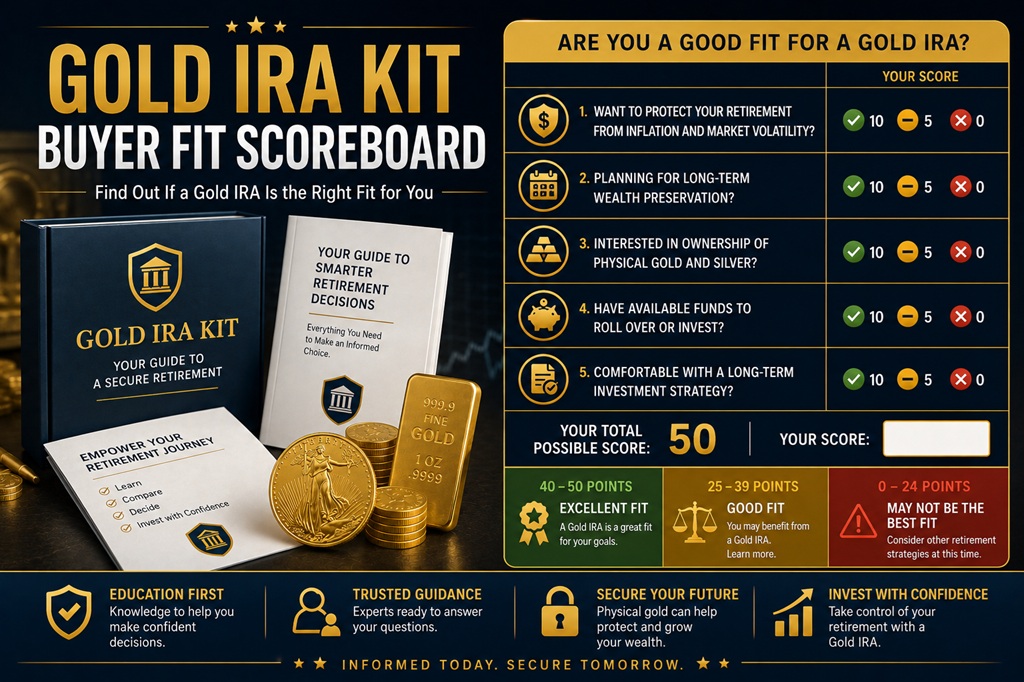
What You Need Before You Start
Most readers request a gold IRA kit first and ask whether the account even fits their situation second. This guide flips that order. You score your own fit across six dimensions before any operator gets your contact details, so the kit you eventually request is one you can actually act on.
Time required: About twenty minutes with a pen and your account statements nearby. Difficulty: Easy. No math beyond adding six small numbers.
Pull these four items together before you score a single dimension.
- A rough dollar figure for the rollover or savings you would move into metals.
- Your age, or your years until you expect to start drawing on the account.
- Your current portfolio mix, so you can see how much room metals would take.
- The name of your existing 401(k) or IRA administrator, if you have one.
Why does a multi-year view belong in a fit score at all? According to World Gold Council research on gold as a strategic asset, in years when inflation ran between 2 percent and 5 percent, the price of gold increased 10 percent (the average annual gain) per year. That decades-long payoff is exactly why your own fit deserves an honest score before you act.
Step 1: Score Your Rollover Size Against Operator Minimums
Start with the number that decides whether you are even the right customer. Write down what you would realistically move into a gold IRA, then score it against the operator minimums in the funnel. The five vetted companies on this site set floors that range from a 10,000 dollar entry to a 50,000 dollar threshold.
Why this matters: A rollover below an operator's minimum is a non-starter, so this dimension filters the field before anything else does.
Award yourself three points if your rollover is 50,000 dollars or more, which opens every operator including Augusta Precious Metals. Award two points for 25,000 dollars to 49,000 dollars, the band where Goldco fits cleanly. Award one point for 10,000 dollars to 24,000 dollars, where American Hartford Gold sits alongside Noble Gold as the entry options. Score zero below 10,000 dollars, where a gold IRA rarely clears its own fixed costs. Waiting for the number to grow can cost you, according to Tim Schmidt, summarizing the timing question on a recent operator call.
The main thing is you lose money by waiting. I mean, I waited too long and saw the gold price triple before I got in my IRA. I think it's just interviewing a couple of companies, see which one you're more comfortable with.
Tim Schmidt Sr., May 2026 (operator call)
Watch out for: Forcing a sub-minimum balance into the wrong operator. Match your number to the floor rather than stretching to meet a pitch.
Step 2: Score Your Time Horizon to Retirement
Next, score how long the metal would actually sit in the account. A gold IRA is a buy-and-hold instrument, not a trading vehicle, so the more years you have, the better the fit. Your age and your expected drawdown date drive this dimension.
Why this matters: A long runway lets the metal ride out price swings, while a short one exposes you to selling into a down year.
Give yourself three points if you are 15 years or more from drawing on the account, two points for 7 to 14 years, and one point for 3 to 6 years. Score zero if you expect to start withdrawals within three years, because the holding window is too short to absorb a downturn. Required minimum distributions begin at age 73 for Traditional accounts, which sets the far end of most readers' horizon. The point of the metal is to hold it, and selling early just burns fixed fees on the way out.
Watch out for: Treating gold like a short-term trade. The fixed custodian and storage costs only make sense across a multi-year hold, so a tight horizon should pull your score down honestly.
Step 3: Score Your Risk Tolerance and Allocation Room
Now score how much room your portfolio has for metals and how comfortable you are holding a non-yielding asset. A gold IRA works as a portion of a retirement portfolio, not the whole thing, and the standard guidance gives you a clear band to measure against.
Why this matters: Over-allocating to metals concentrates risk, while under-allocating wastes the diversification the asset is meant to provide.
Award three points if you can place 5 percent to 20 percent (the standard band) of your portfolio in metals without overcommitting. Award two points if you have room for roughly 5 percent to 10 percent (the common weight), one point if metals would crowd out other holdings, and zero if a gold position would push you past a prudent share of your savings. The band itself is well established, according to Tim Schmidt, summarizing the allocation question on a recent operator call.
People do recommend 5 to 20 percent. Most people go between 5 and 10. If you stay within that number as your portfolio either earns or loses money over the years, that's probably a good range to just keep inside.
Tim Schmidt Sr., May 2026 (operator call)
Watch out for: A sales pitch that nudges you toward a 50 percent metals allocation. Anything far above the standard band is a red flag, not a strategy.
Step 4: Score Your Existing Rollover Eligibility
Then score whether you actually have funds you can move without a tax hit. A gold IRA is usually funded by rolling over an existing 401(k) or IRA, and the cleanest path is a direct trustee-to-trustee transfer.
Why this matters: The right funding path moves money with no withholding, while the wrong one hands a slice to the government on the way in.
Give yourself three points if you hold an eligible 401(k) from a former employer or a Traditional IRA you can transfer directly. Award two points for a current-employer plan that allows in-service rollovers, one point if only new annual contributions are available, and zero if you have no rollover-eligible funds at all. Under IRS Publication 590-B, a direct transfer moves funds with no taxes withheld and no 60-day deadline, while an indirect rollover triggers a 20 percent (the mandatory withholding rate) federal bite. For 2026, fresh annual contributions are capped at 7,500 dollars under IRS Notice 2025-67, plus a 1,100 dollar catch-up at age 50 and older, so most accounts of any size start with a rollover.
Watch out for: Taking a check from your old administrator yourself. That is the indirect path, and the withholding turns a 100,000 dollar transfer into an 80,000 dollar problem.
Step 5: Score Your Comfort With Fixed Fees and Storage
Score how you feel about paying fixed annual costs to hold metal in a vault. A gold IRA carries custodian, storage, and setup fees that a standard brokerage IRA does not, and your comfort with those line items is a real fit signal.
Why this matters: Readers who resent every fixed dollar tend to abandon the account, while those who treat fees as the cost of physical ownership stay the course.
Award three points if fixed annual fees of roughly 200 dollars to 250 dollars on a funded account read as reasonable to you. Award two points if you accept them with a clear schedule in writing, one point if they give you pause, and zero if any recurring fee is a dealbreaker. Per Money.com benchmarking of gold IRA providers in 2026, storage fees often range from 100 dollars to 150 dollars per year and setup fees range from 50 dollars to 200 dollars. So how much does a fixed fee really cost? A flat 225 dollar annual fee is 0.9 percent (a real drag) of a 25,000 dollar account, 0.45 percent (a mid-tier drag) of a 50,000 dollar account, but only 0.225 percent (a rounding error) of a 100,000 dollar account, so the bigger your balance, the lighter the fee feels. On a 250,000 dollar account that same fee is 0.09 percent (a rounding error), barely a footnote against the metal. Storage style is part of this comfort check, according to Tim Schmidt, summarizing the storage choice on a recent operator call.
Segregated would mean your metals are the exact ones you purchase. It's shipped and stored separately from everyone else's. I think people that maybe have a larger investment want to think about doing segregated. And if you have a smaller investment, co-mingled. But it's a personal preference. Your metals are safe in a depository.
Tim Schmidt Sr., May 2026 (operator call)
Watch out for: A quoted number that buries a percentage of assets in the fine print. You want the full fixed schedule in writing before you score this dimension.
Step 6: Score Your Learning Style, Education or Low Minimum
Finally, score how you prefer to learn before you commit. Some readers want a guided, education-first onboarding, and others just want the lowest entry point and a quick start. The funnel serves both, so this dimension points you toward the right operator rather than away from the account.
Why this matters: Matching your learning style to the operator's onboarding posture is what turns a kit into a confident decision rather than a confusing one.
Give yourself three points if you want a structured, education-first process and have the rollover size to match it, two points if you prefer a guided call at a mid-tier minimum, one point if you want the lowest possible entry, and zero only if you are not ready to read anything at all. Augusta Precious Metals leads on education with its one-on-one web conference, while Goldco pairs a guided specialist process with a lower 25,000 dollar minimum. American Hartford Gold opens the door at 10,000 dollars for readers who want the lowest entry point. The five-company kit comparison on this site maps each operator to its onboarding style.
Watch out for: Picking an operator for its minimum alone when your real need is education. The wrong onboarding style is the most common reason a motivated buyer stalls.
Add Up Your Score and Read the Result
Total your six dimensions for a score out of 18 points, then read the result below. The rubric is simple, and it tells you whether to request a kit today, prepare first, or hold off.
A score of 13 to 18 points (a strong fit) means a gold IRA suits your situation, so request a kit now and start comparing operators. A score of 7 to 12 points (a partial fit) means the account could work once you close a gap, such as growing the rollover or extending your horizon, so read a kit to learn while you prepare. A score of 0 to 6 points (a weak fit) means the timing or the size is off, so revisit the scorecard in a year rather than forcing the account now.
Whatever your score, the same IRS rules govern the metal. Under IRC Section 408(m)(3), eligible bullion must meet a fineness floor and stay in the physical possession of a qualifying trustee, with gold at 0.995 (a 99.5 percent standard), silver at 0.999 (a 99.9 percent standard), and platinum and palladium at 0.9995 (a 99.95 percent floor). The American Gold Eagle from the U.S. Mint is the one carve-out, eligible at 91.67 percent (its statutory purity) because the statute names it directly in 31 U.S.C. Section 5112. Home storage is never allowed. In McNulty v. Commissioner, 157 T.C. No. 10, decided in November of 2021, the United States Tax Court determined deficiencies of 250,558 dollars for tax year 2015 against the McNultys for storing IRA-purchased coins at home.
Common Mistakes to Avoid
A handful of scoring errors show up again and again, so flag them before you tally your total.
- You score the operator instead of yourself. This scorecard rates your fit, not the kit's quality. For the kit-side scoring, the gold IRA kit quality framework is the companion tool. These two assessments stay separate so each one reads honestly.
- You inflate the rollover-size score. Readers often round a 12,000 dollar balance up to the next tier to unlock a preferred operator. Score the number you actually have, because the minimum is a hard floor and not a suggestion.
- You ignore a low time-horizon score. A strong rollover size cannot rescue a three-year horizon. If Step 2 scores low, weight it heavily, since selling metal into a down year near retirement is the costliest mistake in this whole process.
What to Expect After You Score Yourself
Once you have a total, the next move follows directly from the rubric. A strong-fit score points you to the kit-request step the same day, and the request itself is quick. You pick the operator whose minimum matches your rollover, submit your details, and the kit arrives by email within minutes, followed by a phone call.
A partial-fit score sends you to read a kit for education while you close the gap, with no obligation to fund anything. A weak-fit score means you set a calendar reminder to re-score in a year as your balance or horizon changes. Across all three outcomes, cross-reference any operator at the Better Business Bureau before a single dollar moves.
Frequently Asked Questions
What score means a gold IRA is right for me?
A total of 13 to 18 points out of 18 signals a strong fit, so you can request a kit and start comparing operators with confidence. A score of 7 to 12 points means a partial fit, where the account could work after you close one gap such as rollover size or time horizon. Below 7 points, the timing or the size is off, and re-scoring in a year is the smarter move.
Should I score myself before or after requesting a kit?
Score yourself first. The point of this self-assessment is to know whether a gold IRA fits your situation before any operator has your contact details. Once you have a strong-fit score, you request the kit that matches your rollover size and walk into the follow-up call already knowing the account suits you.
How much of my portfolio should a gold IRA be?
Most retirement investors keep 5 percent to 20 percent of a portfolio in metals, and many anchor near 5 percent to 10 percent. Anything far above that band concentrates risk rather than diversifying it. Step 3 of the scorecard turns that guidance into a point score so you can measure your own allocation room honestly.
Which gold IRA company fits a smaller rollover?
For a rollover in the 10,000 dollar to 20,000 dollar range, American Hartford Gold sits alongside Noble Gold as the entry-tier options. Goldco fits cleanly at the 25,000 dollar minimum, and Augusta Precious Metals serves rollovers of 50,000 dollars and above. Your Step 1 score points you to the right tier before you request anything.
Risk Warning: Precious-metals prices can be volatile. A gold or silver IRA is subject to IRS rules, custodian fees, and storage costs that affect net returns. Past performance does not predict future results. This article is educational only and is not investment, tax, or legal advice. Consult a qualified professional before any retirement-account decision.
To act on a strong-fit score, request the free Goldco information kit and read the operator-attested fee schedule and the IRA-approved product list before any phone contact.
About the Author
Tim Schmidt Sr. has been covering precious-metals investing since 2012. He founded IRAInvesting.com that year and has spent more than a decade evaluating gold IRA companies, custodians, and depositories firsthand as a personal account holder at Goldco, Augusta Precious Metals, American Hartford Gold, and Noble Gold. He serves as VP Business Development at Cayman Financial Review and operates Ice Cold Marketing from Weston, Florida. His commentary has appeared on CNBC and Yahoo Finance.
Reviewed by Sean Webster, CPA
Sean Webster is a Certified Public Accountant who reviewed this article for accuracy on the fee, allocation, and IRS-rule figures cited throughout.