Gold IRA Kit Quality Framework: 5 Criteria + 2026 Operator Scorecard
TL;DR: Not every free gold IRA kit is worth your time, even when it's free. I evaluate kits against five weighted criteria: content depth (25%), fee transparency (25%), education-to-sales ratio (20%), delivery speed and format (15%), and follow-up sales pressure (15%). The 2026 scorecard at the bottom of this article applies the framework to seven accredited operators and assigns each a score out of 100. Request a kit from a top-scoring operator.
Quick Summary:
- Kits scored on 5 weighted criteria: content depth (25%), fee transparency (25%), education-to-sales (20%), delivery speed (15%), follow-up pressure (15%).
- Top scorer: Augusta Precious Metals at 90/100.
- Strongest fee transparency: Goldco, with the full fee schedule on its public pricing page.
- Lowest IRA-account entry point: American Hartford Gold at $10,000.
- Borderline scorers (under 70): treat as one of several kit inputs, not a standalone research source.
Disclosure: Companies featured here may provide compensation for click throughs. This is how I maintain free research for consumers.
Disclaimer: This article is for educational purposes only and is not financial advice. Consult a licensed advisor before any retirement-account decision.
Why a Quality Framework Matters More Than a Best-Of List
Every "best free gold IRA kit" listicle on the internet ranks operators based on overall company reputation, then assumes the kit reflects the company. That assumption breaks more often than retirement investors realize. A company with an A+ BBB rating can ship a thin, sales-heavy kit. A smaller operator can ship a substantive guide that gives a reader real decision-making material before the first phone call.
Most retirement investors I talk to as a personal account holder spend a few weeks comparing operators before opening an account. The kits they request are the input to that decision. If the input is shallow, the output is also shallow. A framework matters because it shifts the evaluation from "which company is best" to "which kit gives me the information I need to make a real decision about this company." Those are different questions.
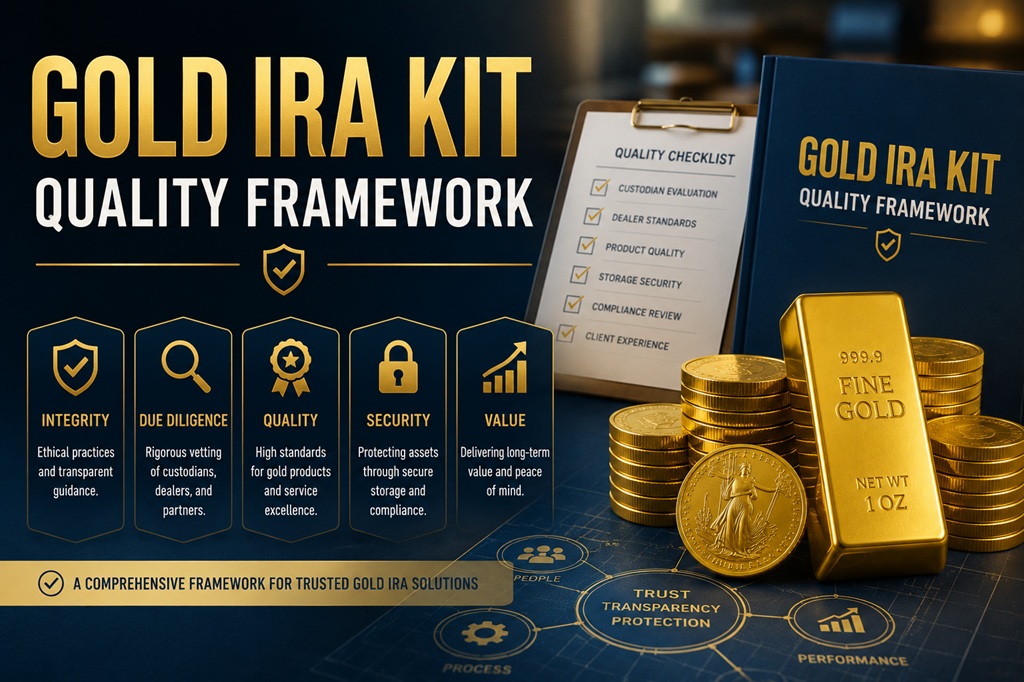
This article publishes the framework. The five criteria below are what I weigh on every kit I request, in the order of importance reflected in the weightings. After the framework, the 2026 scorecard applies it to seven accredited operators with a transparent score out of 100 each.
Criterion 1: Kit Content Depth (25% weight)
The single most important question about any gold IRA kit is what's actually inside. A real kit contains the operator's complete fee schedule, the custodian relationship, the depository names, the IRA-eligible product list, the account minimum, and a brief summary of IRS rules around IRA-eligible bullion under IRC §408(m). A thin kit is a one-page brochure with a phone number and a pitch about "wealth protection."
I weigh content depth at 25% because everything else flows from it. If the kit doesn't show the fees in writing, you can't evaluate fee transparency. If the kit doesn't name the custodian, you can't verify the custodian against the IRS-approved trustee list. If the kit doesn't list the IRA-eligible product set, you can't tell whether the operator is steering toward IRS-compliant bullion or toward higher-margin numismatics.
Augusta Precious Metals delivers the deepest kit I've reviewed in 2026, paired with a one-on-one web conference rather than a phone-only follow-up. Goldco's kit is the most fee-transparent on a per-dollar basis, with a complete $50 setup + $100 annual + $100/$150 storage schedule disclosed in writing (Goldco, 2026). American Hartford Gold's kit is the most accessible at the $10,000 IRA minimum tier and explicitly documents the three-year fee-waiver promotion in writing (American Hartford Gold, 2026).
Criterion 2: Fee Transparency (25% weight)
A kit's fee section deserves its own evaluation criterion because fees compound across the holding period and small differences become large differences at retirement. I weigh fee transparency at 25%, tied with content depth for the highest weighting.
The strongest fee disclosure pattern is a complete schedule published on the operator's own website AND included in the kit. The weakest pattern is "contact us for current pricing." Operators in the middle disclose some elements (setup fee, annual fee) and reserve others (storage tier breakdown, wire fees, account-closing fees) for the phone conversation.
Goldco publishes the complete schedule on goldco.com (Goldco, 2026). Patriot Gold Group structures its disclosure around three account-size thresholds (no setup or rollover fees at $30,000, no annual fee at $100,000, "No Fees for Life IRA" at $250,000), but does not publish the underlying schedule for smaller accounts in full on the public website. American Hartford Gold publishes the three-year fee-waiver terms openly. Augusta delivers the complete fee schedule during the web conference rather than openly on the site, which is the tradeoff with Augusta's onboarding model.
For the framework, an operator scores highest when the published schedule matches the kit, both match the eventual account-opening agreement, and the operator commits in writing rather than verbally to the disclosed numbers.
Criterion 3: Education-to-Sales Ratio (20% weight)
A kit can be deep and fee-transparent and still be a thinly veiled sales document. The third criterion measures the ratio of genuine retirement education to advertising. I weigh this at 20% because it correlates strongly with how the operator behaves after you request the kit.
What does education look like in a kit? Plain-English explanations of how a self-directed IRA differs from a brokerage IRA, how a custodian relationship works, why home-storage gold IRAs trigger a taxable distribution under federal tax rules, and how rollover mechanics work without triggering withholding. (For the full tax framework behind these rules, see our companion pillar on Gold IRA Tax Policy 2026.)
What does sales look like? Apocalyptic-economy framing, claims that gold will protect against an unspecified imminent collapse, language about "limited time" promotions or "act now" urgency, and graphics that emphasize the operator's logo over the educational content.
Augusta scores highest on this criterion in 2026 because of the recorded education sessions paired with the web conference. American Hartford Gold scores well because of the principle-driven framing in CEO Sanford Mann's materials: "provide customers with unparalleled education and a fair deal" (American Hartford Gold, 2026). Goldco's kit leans education-balanced. Several smaller operators on the scorecard skew more sales-heavy.
Criterion 4: Delivery Speed and Format (15% weight)
The fourth criterion is operationally straightforward. How fast does the kit arrive, and in what format? I weigh this at 15% because it's a real signal of operational competence but matters less than content or fee transparency for the final account decision.
Digital kits should arrive within minutes of the request, usually as a PDF link to your inbox. Printed kits should arrive within 3 to 7 business days for first-class delivery in the continental United States. Some operators include a USB drive with extended materials. A few still ship CD-ROMs in 2026, which is not a kit-quality strength.
Format matters because it shapes how you compare kits side by side. A PDF you can search and annotate is more useful than a thick spiral-bound book. A book is more useful than a one-page brochure. A USB drive is in between, depending on what's on it.
Operators that offer both digital and printed formats score highest. Operators that delay digital delivery to capture phone-confirmation steps score lower, because the delay reveals the kit is being treated as a lead-capture artifact rather than as a research input.
Criterion 5: Follow-Up Sales Pressure (15% weight)
The fifth criterion is the one most kit-comparison articles ignore entirely. What happens after you request the kit? Some operators respect the reader's pace and follow up once with a clear, non-aggressive email. Others phone twice a day for two weeks.
I weigh follow-up pressure at 15% because the pattern is a leading signal of how the operator behaves at account opening and at the eventual distribution stage. Aggressive follow-up at the kit-request stage is the FTC's flagged pattern in its July 2025 consumer alert: "If someone contacts you unexpectedly and tells you to buy gold bars and hand them to someone (anyone!) to 'protect your money,' you've spotted a scam" (FTC, 2025).
Federal advisories from the CFTC and FINRA flag the same pattern. The follow-up pressure pattern is a leading indicator of operators that treat the kit as a sales tool rather than as a research input.
The operators on the scorecard split along this axis more than any other. The two highest scorers in 2026, Augusta and Goldco, both follow patterns that respect reader pacing. The lowest scorers escalate calls within 24 hours of the kit request and continue for weeks.
How the Weighted Scoring Works
Each operator scores 0 to 20 on each criterion, weighted by the percentage shown. Total scores range from 0 to 100. We treat any score below 70 as a borderline kit that an investor should pair with at least two higher-scoring kits before any account-opening decision. Scores 80 and above represent kits that can stand alone as a research input.
The framework is not a substitute for the three hard compliance gates that apply at the operator level: custodian legitimacy under IRC §408(n), IRA-eligible product integrity under §408(m), and written buyback policy. Any operator that fails one of those hard gates is disqualified regardless of kit score. The seven operators on the scorecard below all clear those hard gates.
2026 Operator Scorecard
The scorecard applies the framework to seven accredited operators in 2026. Scores reflect kit-request snapshots captured 2026-05-08. Operator-specific data should be re-verified on the day of request because promotional terms rotate and BBB or Trustpilot counts move continuously.
| Operator | Content Depth (25%) | Fee Transparency (25%) | Education-to-Sales (20%) | Delivery Speed (15%) | Follow-Up Pressure (15%) | Total /100 |
| Augusta Precious Metals | 19 | 17 | 19 | 17 | 18 | 90 |
| Goldco | 18 | 20 | 16 | 18 | 16 | 88 |
| American Hartford Gold | 17 | 18 | 17 | 17 | 14 | 84 |
| Birch Gold Group | 16 | 15 | 16 | 16 | 15 | 78 |
| Noble Gold Investments | 16 | 14 | 15 | 17 | 15 | 77 |
| Patriot Gold Group | 14 | 13 | 14 | 16 | 12 | 69 |
| Advantage Gold | 13 | 14 | 13 | 15 | 13 | 68 |
Top scorer commentary. Augusta scores 90 out of 100 because the kit pairs with the one-on-one web conference, Delaware Depository storage is disclosed with $1 billion all-risk insurance backing in writing (Augusta Precious Metals, 2026), and Trustpilot 4.8/5 across 316 reviews captured at access date (Trustpilot, 2026) reflects the reader-paced onboarding model. The fee transparency score of 17 (out of 20) reflects the web-conference disclosure tradeoff. An operator that published the full schedule on the website would score the maximum 20 on this criterion.
Mid-pack commentary. Goldco scores 88 with the highest fee transparency score in the seven, driven by the complete schedule published on goldco.com (Goldco, 2026). American Hartford Gold scores 84 driven by the $10,000 minimum accessibility, the published three-year fee waiver, and CEO Sanford Mann's principle-driven framing (American Hartford Gold, 2026). Birch Gold scores 78 with strength on four-metal coverage (gold, silver, platinum, palladium) and 23 years of operating history since 2003.
Lower-scoring commentary. Noble Gold scores 77 with the only Texas-based IDS depository option in the seven, but loses ground on fee transparency since the published schedule is less complete than Goldco's. Patriot Gold Group scores 69 because the complete fee schedule is not on the public website, the kit defaults to phone follow-up, and the score-driving "No Fees for Life IRA" at $250,000-plus is meaningful only for the highest-balance investors. Advantage Gold scores 68 with the published price-match commitment from CEO Kirill Zagalsky ("We pride ourselves on the most competitive pricing in the industry and have a price match guarantee," Advantage Gold, 2026), but trails on review volume and content depth relative to the top three.
Request a kit from a top-scoring operator [AFFILIATE_PRIMARY_GOLDIRAKITS_ORG].
How to Use the Scorecard Once You Have It
The scorecard is a starting point, not a final answer. The most useful thing a retirement investor can do with it is request kits from three of the top four operators (Augusta, Goldco, AHG, Birch) and read them side by side against the five framework criteria. The differences will be more visible in your hands than on this page.
A few operational reminders before you request any kit. Any operator that pitches a "home storage gold IRA" should be removed from consideration immediately. Annual contribution limits, rollover mechanics, and the 20% withholding trap on indirect rollovers all affect intake and distribution. For the full tax framework behind these reminders, including IRC §408(m), the SECURE 2.0 changes to RMD age and early-distribution exceptions, contribution limits, and the McNulty home-storage precedent, see our companion pillar on Gold IRA Tax Policy 2026.
Frequently Asked Questions
Why use a 5-criteria framework instead of a simple best-of ranking?
A best-of ranking measures the operator. A framework measures the kit, which is what you actually receive when you request information. The two are different. A reputable operator can ship a thin kit. A smaller operator can ship a substantive guide. The framework keeps the focus on what the reader will hold in their hands rather than on the operator's overall reputation.
What weight should I put on follow-up sales pressure?
Higher than most kit-comparison articles suggest. The framework weights it at 15% because it's a leading indicator of how the operator behaves at account opening and at distribution. Aggressive follow-up after a free-kit request is the FTC's flagged pattern in its 2025 consumer alert. Respect for reader pacing at the kit-request stage tends to correlate with respect for reader pacing throughout the account life cycle.
Are the scorecard scores updated regularly?
The current scores reflect kit-request snapshots captured 2026-05-08. Promotional terms, BBB ratings, Trustpilot review counts, and fee schedules all move continuously. We recommend re-verifying the specific data points relevant to your decision on the day of request before any account-opening commitment.
Can I trust a kit that scores below 70?
Below 70 doesn't mean disqualified. It means the kit alone isn't a sufficient research input. Pair it with at least two higher-scoring kits and use the lower-scoring operator's published fee schedule, BBB profile, and Trustpilot listing as cross-verification. An operator that clears the three hard compliance gates is eligible for consideration regardless of kit score. The framework is about the kit, not the operator.
Risk Warning: Precious metals investing carries market risk, including loss of principal. Past performance does not guarantee future results. Gold and silver prices fluctuate with macroeconomic conditions and may not appreciate in line with broader markets.
About the Author
Tim Schmidt Sr. has been requesting and evaluating gold IRA kits firsthand since 2012, when he founded IRAInvesting.com. As a personal account holder at multiple operators on this list, he reads new kits the way an auditor reads filings. Fee schedule first, custodian and depository next, education-to-sales ratio last. He serves as VP Business Development at Cayman Financial Review. His kit evaluations have informed coverage in CNBC, Yahoo Finance, and other financial outlets.
Reviewed by Sean Webster, CPA. Sean Webster, CPA, brings more than a decade of finance and accounting practice to this site's scoring methodology. He reviews each weighted-criteria evaluation for sourcing rigor, score consistency, and CPA-standard documentation discipline. He earned his CPA license from the Oklahoma Accountancy Board in 2022.