Augusta Precious Metals Information Kit 2026: What’s Inside, How the Web Conference Works, Real Patterns
Overall rating: 4.7/5
TL;DR: Augusta Precious Metals delivers the most rigorous education-first kit in the network. The kit anchors a $50,000 minimum, an operator-attested fee schedule, and a one-on-one web conference with Augusta's director of education. The standout differentiator is the conference itself, attended anonymously by Hall of Fame quarterback Joe Montana before he became an Augusta customer.
Disclosure: Companies featured here may provide compensation for click throughs. This is how I maintain free research for consumers.
Disclaimer: This article is educational and not financial, tax, or legal advice. Consult a qualified professional before making retirement-account decisions.
This deep-dive covers the Augusta information kit itself. For the full company evaluation, including the fee schedule, custody partners, complaint record, and our overall scoring, read our Augusta Precious Metals review.
| Augusta Precious Metals | |
| Best For | Rollovers of $50,000 or more |
| Standout Feature | One-on-one web conference led by a Harvard-credentialed education director |
| Minimum Investment | $50,000 (the operator's published floor) |
| Annual Fees | $125 (annual custodian fee) + $100 (annual storage fee) |
| BBB Rating | A+ with zero unresolved complaints since 2012 |
Pros:
- Operator-attested fee schedule reproduced verbatim inside the kit packet
- A+ BBB record with zero unresolved complaints across the operator's full 14-year history
- 0.36 percent of assets annually on a $50,000 account, comparable to many ETF expense ratios
- Direct partnership with Equity Trust Company and Delaware Depository, the two most established names on each side of the structure
Cons:
- $50,000 minimum prices out smaller rollovers that Goldco or American Hartford Gold would accept
- Full fee discussion happens inside the web conference rather than openly published online
- Web conference access caps at a $100,000 qualifying floor for the full education session
What the Augusta Information Kit Actually Is
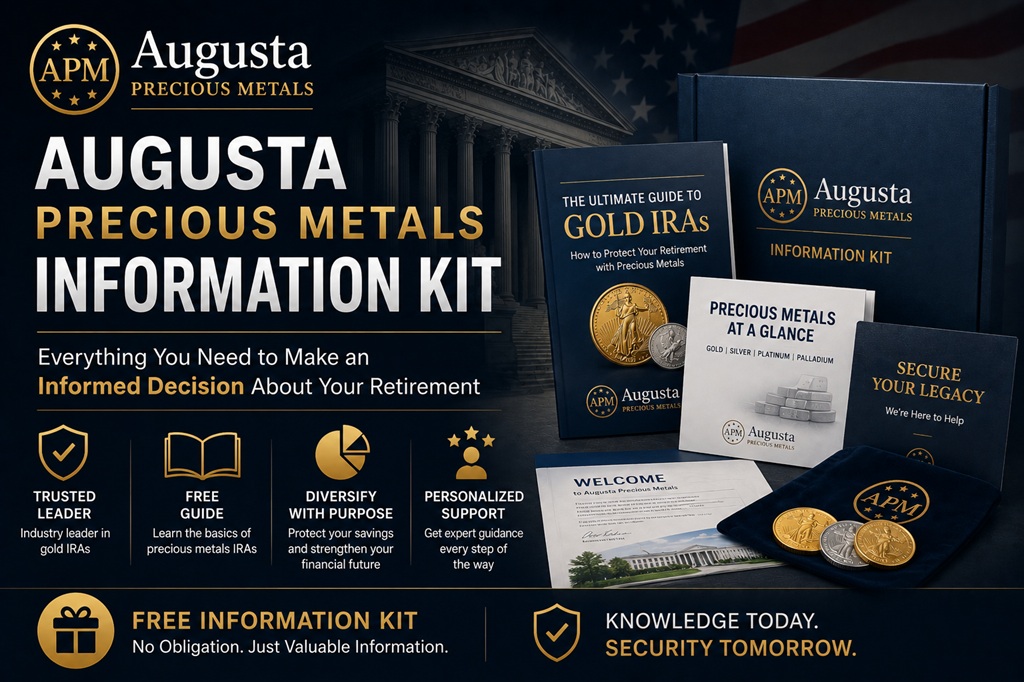
The Augusta information kit is a free printed and digital packet that the operator mails to anyone who requests one. It functions as the first step in the Augusta funnel. The kit is not a sales document. It is an education document, and the sales conversation is intentionally moved into a separate one-on-one web conference that arrives after the kit lands.
The kit explains why Augusta specializes in rollovers above $50,000, walks through the universe of IRS-approved bullion, names the custodian and depository, and previews the fee structure. Augusta describes its own scope as rollover-first. The minimum investment for a Gold or Silver IRA at Augusta is $50,000, per the operator's own gold IRA page.
Who should request the kit? Anyone with a five-figure or six-figure rollover who values education over a faster sales close. Anyone who wants the BBB profile, the Trustpilot record, and the fee math in a printed packet before any phone call. Anyone willing to sit through a one-hour web conference before committing money.
What Is Inside the Kit
The Augusta kit is built around four blocks. The first explains the IRS-eligible product universe. The second walks through custodian and depository mechanics. The third previews the fee schedule. The fourth introduces the web conference and how to register.
The product block teaches the rule that matters most. Under IRC Section 408(m)(3), gold, silver, platinum, or palladium bullion is excluded from the collectibles prohibition only when it meets a fineness floor and sits in the physical possession of a qualifying trustee. The gold floor is 0.995 (the COMEX-deliverable specification), which is locked into the statute under IRC Section 408(m)(3). The silver floor is 0.999 (a fineness floor most modern silver bullion meets natively). The kit lists eligible coins including the American Gold Eagle, American Gold Buffalo, American Silver Eagle, Canadian Gold Maple Leaf, and Austrian Vienna Philharmonic. It also names what does not qualify, including pre-1933 U.S. coins, the South African Krugerrand, and rare or numismatic coins valued above their bullion melt.
The mechanics block covers the three-role structure every IRA holder needs to internalize. The custodian holds title and executes the owner's instructions. The dealer, Augusta itself, sells bullion to the custodian on the owner's behalf. The depository, an IRS-approved facility, holds the metal in physical possession. None of these roles can be merged. The role separation is what keeps the structure inside the IRC Section 408(m)(3) carve-out rather than triggering a deemed distribution.
The fee block previews pricing without burying it, which is unusual for a $50,000-minimum operator. The web-conference block introduces Devlyn Steele as the director of education and explains how the one-on-one session is scheduled after the kit is reviewed.
Augusta Company Profile
Augusta Precious Metals was founded in 2012 by Isaac Nuriani, who remains the operator's chief executive. The company headquarters sits in Casper, Wyoming, with sales and education offices in Beverly Hills, California. Augusta specializes in self-directed precious-metals IRAs at the $50,000 minimum tier and runs a sales structure built around education rather than the fast-close model used by some lower-minimum competitors.
The credibility floor is the cleanest read of Augusta's record. The operator carries an A-plus rating with the Better Business Bureau and zero unresolved complaints since opening its doors in 2012. The credibility floor matters, according to Tim Schmidt, because it confirms that complaints get logged, vetted, and responded to over a full 14 (consecutive years of BBB-accredited operating history) without the unresolved tail that flags weaker operators. The Trustpilot profile shows a TrustScore of 4.8 (out of 5 stars) across 328 (independent reviewer entries) as of access date.
The standout policy in Augusta's company profile is the education-first sales structure. Augusta does not pay its specialists on a per-sale commission tied to specific products. Instead the conference and the kit do the heavy lifting up front, which is why a 50,000 dollar floor exists in the first place. The economics only work when each call closes a meaningful rollover rather than a small first-purchase ticket.
Does a Trustpilot score, a BBB rating, and an education-first sales structure prove anything on their own? No. They establish credibility floors. They do not replace the kit, the conference, or the contract review.
The Fee Schedule You Will See in the Kit
Augusta's information kit previews pricing without burying it. The number that anchors every other decision is the minimum: $50,000. Annual costs are fixed in dollars, which is the right structure for a custodian arrangement at this account size. Here is the operator-attested fee schedule exactly as Augusta publishes it inside the kit and on its primary gold IRA page.
Fee schedule (Augusta Precious Metals, operator-attested 2026):
Minimum Investment
You must make a minimum investment of $50,000 to open a Gold or Silver IRA with Augusta Precious Metals.
Fee Breakdown
Fees include a one-time $50 setup fee, and annual fees around $225 ($125 for the custodian and $100 for storage). There are no management fees.
First-Year & Ongoing Costs
Your estimated first-year all-in cost is approximately $425, and over five years you can expect to pay roughly $1,825 in total custodial and storage fees. For a $50,000 account, the $180 fixed annual cost represents 0.36% of assets annually, comparable to many ETF expense ratios.
What does this fee stack mean in practice? Year-one billing combines the $50 (one-time setup fee), the $125 (annual custodian charge), and the $100 (annual storage charge). Year two drops back to just the custodian and storage charges because the setup fee is one-time. Across five years the holder pays roughly $1,825 (total custodial and storage fees over five years), which is the cleanest number to compare against alternatives.
The fee schedule is fixed, which is the variable I care about most. Industry-wide, storage and custodian fees can run from $10 to $60 (per month, across the broader custodian market) or 0.35 percent to 1 percent (annually as a percentage of assets), per Money.com's 2026 gold-IRA company benchmark. On a six-figure account, a percentage-fee custodian charging 1 percent costs the holder many times what Augusta's fixed annual cost runs. The fixed-fee math is the right math, especially as the account grows.
The One-on-One Web Conference and the Education-First Model
The Augusta web conference is the single most distinctive element of the kit funnel. The conference runs roughly one hour and is led by Devlyn Steele, the operator's director of education. Steele has processed more than $2 billion (in financial assets across his three-decade financial services career). He is a member of the business analytics program at Harvard Business School. The conference covers market cycles, inflation risk, allocation theory, and the dealer tactics worth avoiding before any purchase decision.
The conference is free and there is no obligation to fund an account afterward. Augusta describes the qualifying floor as $100,000 (in retirement savings to access the full one-on-one session), which lines up with Augusta's broader account-tier positioning. The same web conference was attended anonymously by Hall of Fame quarterback Joe Montana, who became an Augusta customer and corporate ambassador after sitting through it. The recognition is not the reason to attend, but it does tell you something about the conference's depth.
Here is how Tim describes the Augusta differentiator from a recorded operator call:
[Augusta has] emerged over the last several years to being a company that's kind of set themselves apart with their education. You get a one-on-one web conference with a Harvard-educated man who takes you through the process, Devlin Steele. They have an impeccable record online with BBB. I've sent a lot of people there to do business and they've been very happy.
Tim Schmidt Sr., May 2026 (operator call)
The conference is the right preparation for a $50,000 or larger rollover. It pairs the kit's printed material with a real-time discussion that covers fee detail and allocation modeling. For a deeper kit-to-call walkthrough of the structurally similar Goldco approach, see the full Goldco information kit deep-dive on this site.
Real Patterns: What Kit Requesters Should Watch For
The kit does not market itself as a fraud-detection document, but reading it carefully exposes the patterns that separate legitimate operators from bad actors. The kit's repeated emphasis on IRS-approved bullion, the qualifying-trustee structure, and operator-attested fees matches the federal red-flag framework the Commodity Futures Trading Commission publishes for retail precious-metals fraud. That framework names diagnostic markers including an agreement that does not identify the financial institution loaning funds, an agreement that does not identify where the physical metal is located, and a counterparty that claims precious-metals transactions are not regulated by the CFTC or the National Futures Association.
The kit's mechanics block addresses the second red flag directly. It names Delaware Depository as the storage facility and describes the $1 billion (in all-risk insurance coverage backed by leading London underwriters), which is the only legal way to hold IRA-eligible bullion outside the holder's own possession. The kit's company-profile block addresses the credibility floor through Augusta's full 14-year BBB record and the Trustpilot aggregate.
Bullion versus collectibles is the misconception that puts more retirement savings at risk than any other. Specialty and numismatic coins do not qualify under IRS rules regardless of how the sales conversation frames them. The kit's eligible-coin shortlist is the antidote.
Home storage is the second misconception the kit shuts down. In McNulty v. Commissioner, the U.S. Tax Court held in November 2021 that an owner of a self-directed IRA may not take actual and unfettered possession of the IRA assets. The McNultys' physical possession of the coins constituted a taxable distribution, according to Judge Goeke, in a ruling that produced deficiencies of $250,558 (TY 2015) and $18,094 (TY 2016). The kit is unambiguous on this point. The metal sits with the depository.
How Augusta Compares in the Network
Augusta is not the only operator with a credible kit. The honest answer is that Augusta sits at the high-minimum end of the network alongside Goldco at the mid-tier, with American Hartford Gold and Noble Gold serving lower-minimum kit requesters. For a side-by-side comparison of all five kit-funnel operators on this site, see the five-company kit comparison.
The minimum is the first differentiator. At $50,000, Augusta sits above Goldco's $25,000 minimum and well above the $10,000 floor used by American Hartford Gold and Noble Gold. The fee structure is the second. Augusta runs a flat $125 custodian fee and $100 storage fee, while Goldco runs $100 maintenance plus $100 to $150 storage. American Hartford Gold and Noble Gold both run different fee stacks at their lower-minimum tiers.
| Operator | Minimum | Annual Fees | Standout |
| Augusta Precious Metals | $50,000 (Augusta operator-attested) | $125 (custodian) + $100 (storage) | Education-first onboarding with one-on-one web conference |
| Goldco | $25,000 (Goldco operator-attested) | $100 (maintenance) + $100-$150 (storage) | Buyback guaranteed at highest price |
| American Hartford Gold | $10,000 (AHG operator-attested) | $75-$125 (custodian) + $100 (storage) | Lower minimum, mass-market |
| Noble Gold | $10,000 (Noble Gold operator-attested) | $80 (account) + $150 (insurance and segregated storage) | Alternative metals including platinum and palladium |
What does the comparison mean for your decision? If your rollover is under $25,000, request American Hartford Gold or Noble Gold's kit first. If you are between $25,000 and $50,000, Goldco's mid-tier structure is the cleanest fit. Above $50,000, Augusta becomes the natural shortlist anchor. Most readers should request two or three kits and read them side by side. The full Augusta operator review on this site walks through the kit-to-conference flow in deeper detail.
Frequently Asked Questions
What exactly comes in the Augusta information kit?
The kit contains a printed and digital packet with four blocks. The first is an IRS-approved product overview covering eligible coins and bullion. The second is a custodian and depository mechanics primer. The third is the operator-attested fee schedule. The fourth introduces the one-on-one web conference and how to schedule it with Augusta's education team.
Is the Augusta web conference really free with no obligation?
Yes. There is no purchase requirement, no upfront fee, and no commitment to fund an account afterward. Augusta describes a qualifying floor of $100,000 or more in retirement savings to access the full one-on-one conference. The recorded education sessions are available to a broader audience.
What is Augusta's minimum to open a gold IRA?
The minimum is $50,000. That floor sits above Goldco's $25,000 minimum and well above the $10,000 thresholds at American Hartford Gold and Noble Gold. If your rollover is under $50,000, request a lower-minimum operator's kit first and revisit Augusta when your account grows.
What should I check before acting on the kit?
Confirm three items. First, verify that any metals quoted in your post-conference proposal are IRS-approved bullion or statutorily listed coins under IRC Section 408(m)(3), not numismatics. Second, confirm the custodian is Equity Trust Company and the depository is Delaware Depository as the kit previews. Third, get the fee schedule in writing exactly as the verbatim kit block shows it.
Request the free Augusta information kit to read the operator-attested fee schedule, review the eligible-product list, and schedule the one-on-one web conference before any phone call.
Risk Warning: Precious-metals prices can be volatile. Gold and silver IRAs are subject to IRS rules, custodian fees, and storage costs that affect net returns. Past performance does not predict future returns. This article is educational only and not investment, tax, or legal advice. Consult a qualified professional before any retirement-account decision.
About the Author
Tim Schmidt Sr. has been covering precious-metals investing since 2012. He founded IRAInvesting.com that year and has spent more than a decade evaluating gold IRA companies, custodians, and depositories firsthand as a personal account holder at Augusta Precious Metals, Goldco, American Hartford Gold, and Noble Gold. He serves as VP Business Development at Cayman Financial Review and operates Ice Cold Marketing from Weston, Florida. His commentary has appeared on CNBC and Yahoo Finance.
Reviewed by Sean Webster, CPA
Sean Webster is a Certified Public Accountant with experience advising clients on self-directed retirement-account structures, including precious-metals IRAs. He reviews articles in this series for tax-rule accuracy and FINRA-compliant framing.