Goldco Information Kit: What’s Inside, How It’s Used, Real Patterns
Overall rating: 4.6/5
TL;DR: Goldco's free information kit is the simplest way to evaluate one of the network's top operators before a phone call. It explains the fee schedule, walks through IRA-approved metals, and previews the kit-to-rollover process. The standout differentiator is the buyback program guaranteed at the highest price.
Disclosure: Companies featured here may provide compensation for click throughs. This is how I maintain free research for consumers.
Disclaimer: This article is educational and not financial, tax, or legal advice. Consult a qualified professional before making retirement-account decisions.
| Goldco | |
| Best For | Rollovers of $25,000 or more |
| Standout Feature | Buyback program guaranteed at the highest price |
| Minimum Investment | $25,000 |
| Annual Fees | $100 maintenance + $100 to $150 storage |
| BBB Rating | A+ Accredited since December 9, 2011 |
Pros:
- Operator-attested fee schedule with no hidden markups inside the kit
- 14 years BBB-accredited with a 4.8 Trustpilot score across 1,784 reviews
- Buyback program reduces the exit-liquidity question that worries first-time IRA holders
- Specialist model means a single point of contact through the rollover process
Cons:
- $25,000 minimum is higher than American Hartford Gold or Noble Gold ($10,000)
- Segregated storage costs $50 more per year than non-segregated
- Kit defers some pricing detail to the post-call consultation
What the Goldco Information Kit Actually Is
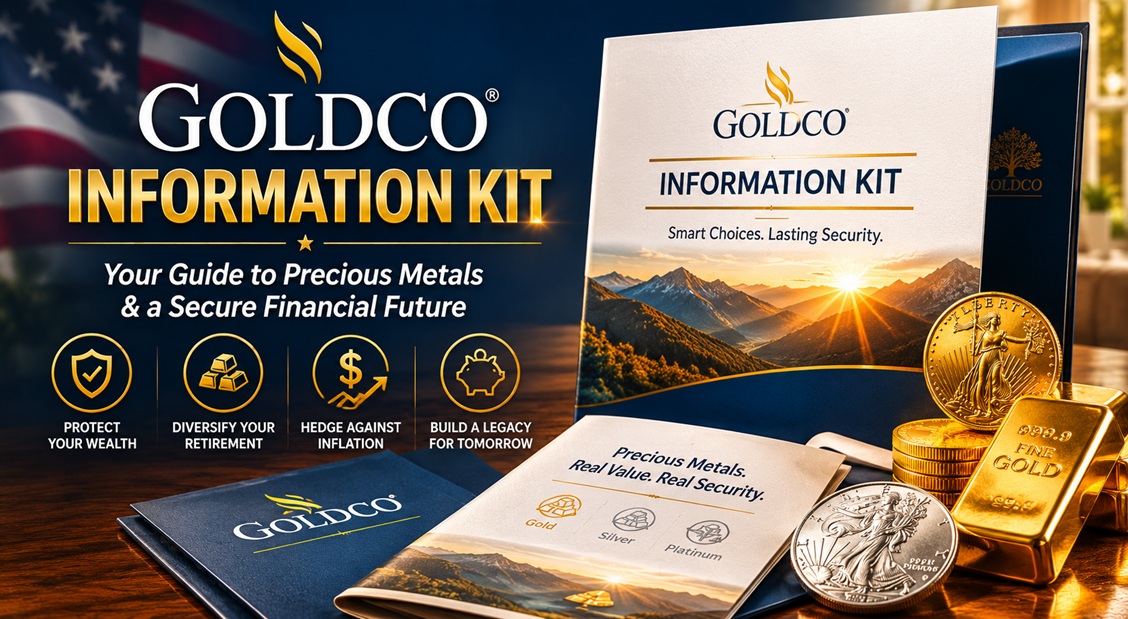
The kit is a free, no-obligation PDF and printed packet that Goldco mails to anyone who requests it. It functions as the entry point for a self-directed precious-metals IRA at Goldco. The kit doesn't replace a sales call. It prepares you for one, which is the smarter way to walk into a $25,000 or larger funding decision.
What the kit actually delivers is a short education. It explains why Goldco specializes in rollovers, what IRA-eligible bullion looks like, the standard custodian setup, and a preview of pricing. Goldco frames its own scope in plain language: the company specializes in rollovers of existing 401(k), 403(b), TSP, and IRA accounts into self-directed Gold and Silver IRAs.
Who is the kit for? Anyone serious about comparing operators before committing money. Anyone who isn't yet sure what bullion versus collectibles means in IRS terms. Anyone whose rollover deserves an hour of reading before a phone call.
What's Inside the Kit
The kit is built around three blocks. The first explains the IRS-approved product universe. The second walks through custodian and depository mechanics. The third previews fees and the kit-to-rollover workflow.
The product block is where most readers learn the rule that matters most. Under IRC Section 408(m)(3), gold, silver, platinum, or palladium bullion is excluded from the collectibles prohibition only when it meets a fineness floor and sits in the physical possession of a qualifying trustee. Gold floor is 0.995 (the COMEX-deliverable specification). Silver floor is 0.999 (the COMEX-deliverable specification for silver).
Inside the kit you'll see the eligible-coin shortlist. The American Gold Eagle is statutorily IRA-eligible under 31 U.S.C. Section 5112 and is the only IRA-eligible coin below 99.5% (the bullion floor), at 91.67% (the 22-karat purity standard). The American Silver Eagle is eligible at 0.999 (a fineness floor it meets natively). Other widely held bullion qualifies when fineness and trustee-custody conditions are met, including the Canadian Maple Leaf. The Austrian Vienna Philharmonic qualifies on the same fineness basis.
The kit also names what isn't eligible. Pre-1933 U.S. coins, South African Krugerrands, and any rare or numismatic coin valued above its bullion melt fail the test. The South African Krugerrand is not enumerated in the statutory carve-out, so it cannot be held inside an IRA.
The block on mechanics covers the three-role structure every IRA holder needs to understand. The custodian holds title and executes the owner's instructions. The dealer (Goldco itself, in this case) sells bullion to the custodian on the owner's behalf. The depository, an IRS-recognized facility, holds the metal in physical possession. None of these roles can be merged, and the McNulty Tax Court holding makes that boundary unambiguous.
Goldco Company Profile
Goldco is a Calabasas, California precious-metals dealer founded by Trevor Gerszt. It has been BBB Accredited since December 9, 2011, and carries an A+ rating with 14 (consecutive years in business) per its Better Business Bureau profile. The company's specialty is rollover facilitation, not direct-purchase brokerage, which shapes how the kit reads.
Independent review aggregation backs the profile. Goldco's Trustpilot profile shows a TrustScore of 4.8 (out of 5 stars) across 1,784 (independent reviewer entries) as of May 19, 2026. The company's own reviews page states a customer review rating of 4.8 (consistent with the third-party score). The credibility floor matters, according to Tim Schmidt, because it confirms that complaints get logged and responded to over a decade-plus operating history.
The standout policy in the company profile is the buyback commitment. Goldco describes it this way on its public-facing profile: purchase your precious metals with confidence knowing that if your circumstances change, the company offers a buy back program guaranteed at the highest price. That commitment matters because the most common worry first-time IRA holders have isn't the purchase. It's the exit.
Does a Trustpilot score and a BBB rating prove anything? On their own, no. They establish credibility floors. They confirm that complaints get logged, vetted, and responded to over a decade-plus operating history. They don't replace the kit, the call, or the contract review.
The Fee Schedule You Will See in the Kit
Goldco's information kit previews pricing without burying it. The number that anchors every other decision is the minimum: $25,000. Annual costs are fixed in dollars, which is what you want from a custodian arrangement. Here is the operator-attested fee schedule exactly as Goldco publishes it on its own reviews page.
Fee schedule (Goldco, operator-attested 2026):
The required minimum purchase at Goldco to start a gold IRA is $25,000. Goldco's preferred Custodian charges a flat annual account service fee which includes a one-time IRA account set-up fee of $50. as well as a $30 wire fee. Annual maintenance is $100, and storage is $150 for segregated storage or $100 for non-segregated storage. Fees for gold storage and custodianship can vary depending on the company you select to handle these services (required by the IRS, as all IRA assets must be managed by a custodian). Depending on the Custodian, storage fees can range from $10 to $60 per month, or as a percentage of assets, from 0.35% to 1% annually.
What does this fee stack mean in practice? Year-one billing combines the $50 setup, the $30 wire, the $100 maintenance, and the $150 segregated storage. Year two drops back to just maintenance and storage because the setup and wire are one-time charges. Non-segregated saves $50 per year, but most operators recommend segregated as an account grows.
The fee schedule is fixed, which is the variable I care about most. Industry-wide, storage and custodian fees range from $10 to $60 per month or 0.35% to 1% annually as a percentage of assets. On a six-figure account, a percentage-fee custodian charging 1% costs the holder many times what Goldco's fixed maintenance and storage costs. The fixed-fee math is the right math.
How the Kit Is Actually Used
The kit isn't designed to sell on the first pass. It's designed to ramp you up so a phone consultation moves faster. The standard flow runs in four steps. You request the kit. You read the kit. You take the follow-up call. You complete the rollover paperwork through the kit's preferred custodian. The whole sequence typically closes in two to three weeks if your existing custodian is responsive.
The funding mechanism the kit walks through is a trustee-to-trustee transfer. Per IRS rollover guidance, if you're getting a distribution from an IRA, you can ask the financial institution holding your IRA to make the payment directly from your IRA to another IRA or to a retirement plan. No taxes will be withheld from your transfer amount. Trustee-to-trustee transfers are not rollovers under Section 408(d)(3)(B) and are not subject to the one-per-12-month limit.
What does the kit-to-call sequence actually feel like once you're inside it? Here is my own account of the onboarding, recorded on an operator call.
GoldCo is very informative when you onboard with them and they're very professional, educating you about the metal options that they have and then talking about the exact purchases you can make with them. And they're very swift working with the custodian. The process was good, everything was done on DocuSign, so I didn't have to do any FedExing of paperwork or anything. They made it very easy.
Tim Schmidt Sr., May 2026 (operator call)
The DocuSign point matters. Older operators still rely on fax-and-FedEx paperwork that slows the rollover by a week or more. The kit previews the digital-first flow, which is one reason rollovers at this operator typically close inside three weeks rather than five or six. For a deeper kit-to-rollover walkthrough specific to Goldco, see the full Goldco operator review.
Real Patterns: What Kit Requesters Should Watch For
The kit doesn't market itself as a fraud-detection document, but reading it carefully exposes the patterns that separate legitimate operators from bad actors. The kit's repeated emphasis on IRS-approved bullion, qualified trustees, and operator-attested fees matches the federal red-flag framework the CFTC publishes for retail precious-metals fraud. That framework names three diagnostic markers: an agreement that doesn't identify the financial institution loaning you money, an agreement that doesn't identify where the physical metal is located, and a counterparty that claims precious-metals transactions aren't regulated by the CFTC or the National Futures Association.
The kit's product block addresses the second red flag directly. It tells you the metal is held at a named IRS-approved depository, which is the only legal way to hold IRA-eligible bullion outside your own possession. The kit's company-profile block addresses the credibility floor through a 14-year BBB record and the Trustpilot aggregate.
Bullion versus collectibles is the misconception that puts more retirement savings at risk than any other. As Schmidt has said about IRA-eligible products, bullion is gonna be where they want to go. It's either IRA approved coin or bar. Not a collectible. That's the main takeaway. Collectibles, pre-1933 coins, and rare numismatics are the categories where dealers extract the biggest markups. The kit's eligible-coin shortlist is the antidote.
Home storage is the second misconception the kit shuts down. In McNulty v. Commissioner, the U.S. Tax Court held in November 2021 that an owner of a self-directed IRA may not take actual and unfettered possession of the IRA assets. The McNultys' physical possession of the coins constituted a taxable distribution, according to Judge Goeke, in a ruling that produced deficiencies of $250,558 (TY 2015) and $18,094 (TY 2016) against them for storing IRA coins at home. The kit is unambiguous: the metal sits with the depository.
The scale of historical fraud in this market is worth understanding before you sign anything. In CFTC v. TMTE / Metals.com, filed September 2020 jointly with 30 state regulators, the defendants fraudulently solicited and received over $185 million in customer funds, including more than $140 million in retirement savings, from at least 1,600 persons. The overcharges averaged from 100 percent to more than 300 percent over the prevailing market price. That case is the cleanest reason to demand operator-attested fees in writing before any rollover paperwork moves.
How Goldco's Kit Compares in the Network
Goldco isn't the only operator with a credible kit. The honest answer is that it sits in a top-tier alongside Augusta Precious Metals at the high end, with American Hartford Gold and Noble Gold serving lower-minimum kit requesters. For a side-by-side comparison of all five kit-funnel companies on this site, see the five-company kit comparison.
The minimum is the first differentiator. At $25,000, Goldco sits above the $10,000 floor used by American Hartford Gold and Noble Gold, and below Augusta's higher entry minimum. The fee stack is the second. Per Money.com's 2026 gold-IRA company benchmark, American Hartford Gold charges an annual IRA fee of $75 for accounts valued at $100,000 or less and $125 for accounts of $100,001 or more, a $100 annual storage fee, and has a $10,000 minimum order. Noble Gold customers pay two annual fees, an $80 account fee and a $150 fee for insurance and segregated storage.
| Operator | Minimum | Annual Fees | Standout |
| Goldco | $25,000 | $100 + $100-$150 storage | Buyback guaranteed at highest price |
| American Hartford Gold | $10,000 | $75-$125 + $100 storage | Lower minimum, mass-market |
| Noble Gold | $10,000 | $80 + $150 insurance/segregated | Alternative metals (Pt, Pd) |
| Augusta Precious Metals | $50,000 | $125 + $100 storage | Education-first onboarding |
What does the comparison mean for your decision? If your rollover is under $25,000, request American Hartford Gold's or Noble Gold's kit first. If you're between $25,000 and $50,000, Goldco's buyback program is the cleanest mid-tier choice. Above $50,000, Augusta becomes the natural shortlist anchor. Most readers should request two or three kits and read them side by side.
Frequently Asked Questions
What exactly comes in the Goldco information kit?
The kit contains a PDF and printed packet with three blocks. The first is an IRS-approved product overview covering eligible coins and bullion. The second is a custodian and depository mechanics primer. The third is a fee preview and a kit-to-rollover process summary. A follow-up phone call from a Goldco specialist is scheduled after delivery.
Is the Goldco kit really free with no obligation?
Yes. There's no purchase requirement, no upfront fee, and no commitment to schedule a call. Goldco recovers the cost of the kit through customers who eventually fund IRAs after reading it. That model is the industry standard for the top-tier operators.
What is Goldco's minimum to open a gold IRA?
The minimum is $25,000. That floor sits above American Hartford Gold's and Noble Gold's $10,000 thresholds and below Augusta Precious Metals' $50,000 minimum. If you're rolling over less than $25,000, request a lower-minimum operator's kit first.
What should I check before acting on the kit?
Confirm three things. First, verify that the metals quoted in your post-call proposal are IRS-approved bullion or statutorily listed coins, not numismatics. Second, confirm the custodian and depository names match what the kit previews. Third, get the fee schedule in writing exactly as the kit's verbatim block shows it. If anything diverges, ask why before signing.
Request the free Goldco information kit to read the operator-attested fee schedule and the IRA-approved product list before any phone call.
Risk Warning: Precious-metals prices can be volatile. Gold and silver IRAs are subject to IRS rules, custodian fees, and storage costs that affect net returns. Past performance does not predict future returns. This article is educational only and not investment, tax, or legal advice. Consult a qualified professional before any retirement-account decision.
About the Author
Tim Schmidt Sr. has been covering precious-metals investing since 2012. He founded IRAInvesting.com that year and has spent more than a decade evaluating gold IRA companies, custodians, and depositories firsthand as a personal account holder at Goldco, Augusta Precious Metals, American Hartford Gold, and Noble Gold. He serves as VP Business Development at Cayman Financial Review and operates Ice Cold Marketing from Weston, Florida. His commentary has appeared on CNBC and Yahoo Finance.
Reviewed by Sean Webster, CPA
Sean Webster is a Certified Public Accountant with experience advising clients on self-directed retirement-account structures, including precious-metals IRAs. He reviews articles in this series for tax-rule accuracy and FINRA-compliant framing.